Every company wants more visibility.
More impressions. More traffic. More engagement. More share of voice.
But visibility alone does not make a brand memorable.
The brands that truly stand out are the ones that give audiences a clear reason to pay attention. They know what they stand for, express it consistently, and evolve without losing the qualities that made them credible in the first place.
That matters even more as AI accelerates content production and makes it easier for every company to publish more, more often.
When everyone can create content, distinctiveness becomes the advantage.
Evolve Without Losing Brand Equity
Companies often reach a point where the business has moved faster than the brand.
Capabilities expand. Markets change. New technology reshapes the category. But the company’s identity, messaging, or digital presence still reflects an earlier version of the organization.
That does not always mean starting over.
Often, the strongest brand transformations identify what has already earned trust and build the future around it.
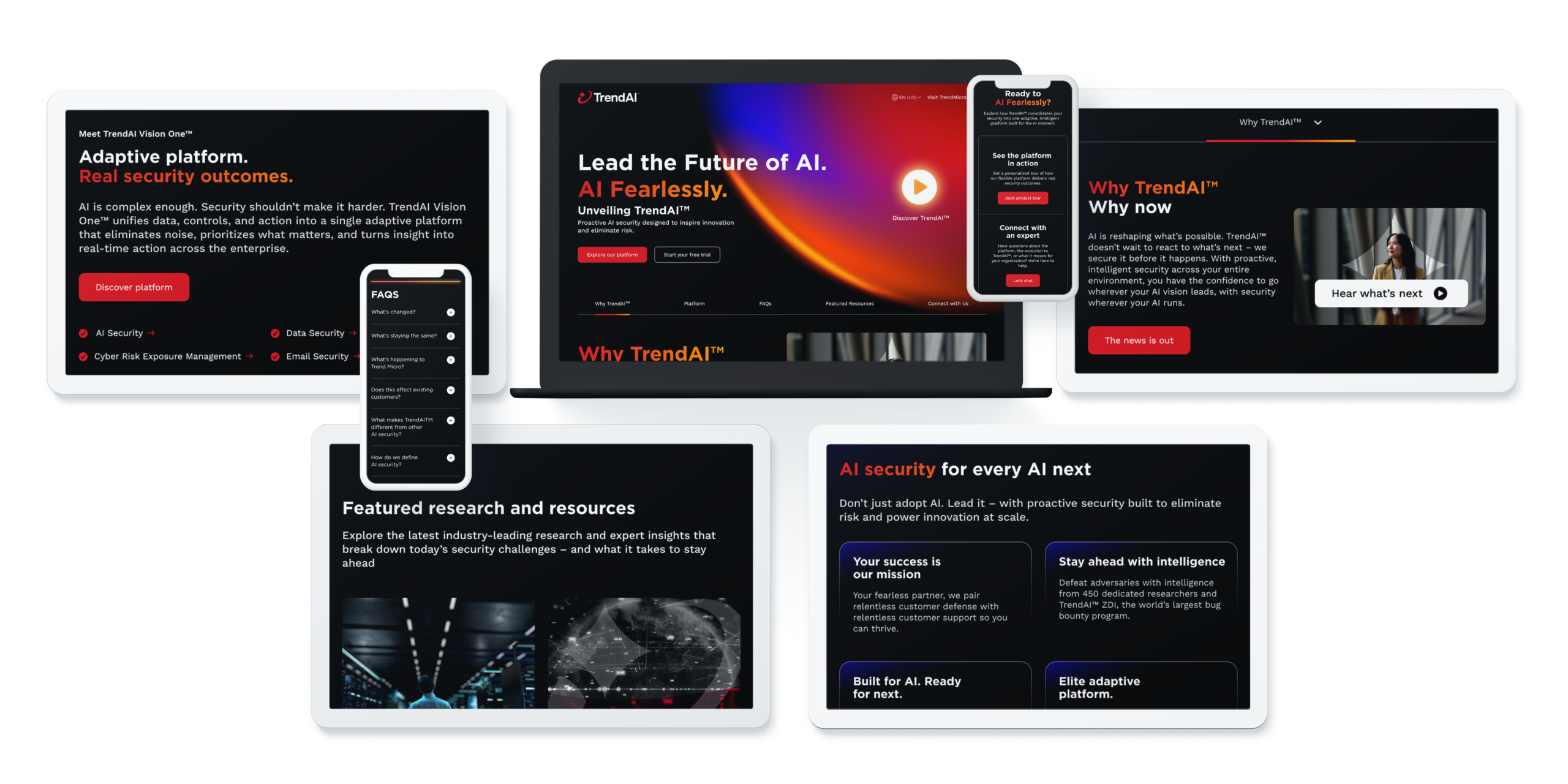
That was the challenge when Trend Micro’s enterprise business evolved into TrendAI.
After decades in cybersecurity, the organization had significant brand equity. The objective was not to abandon that history, but to create a brand capable of signaling where the business was headed next.
The new identity, website, brand video, and go-to-market campaign came together around a simple rallying cry:
AI Fearlessly.
Strong brand evolution should do exactly that. It should make the future clear without making the past irrelevant.
Turn Expertise Into Content That Travels
Most organizations do not have a shortage of expertise.
They have a packaging problem.
Important perspectives are often trapped inside long-form reports, technical presentations, executive conversations, and dense white papers that only reach a fraction of the intended audience.
That is why motion content is becoming increasingly important to modern thought leadership.
A strong idea should be able to travel.
One strategic point of view can become an executive video, animated explainer, social clip, event asset, website experience, or sales enablement piece.
For B2B and B2G organizations in complex industries, that matters because the subject matter is often difficult to explain quickly.
Video, animation, and visual storytelling can make sophisticated ideas easier to understand without making them less substantive.
The goal is not simply to create more content.
It is to make the company’s best thinking easier to consume, remember, and share.
Make Your Positioning Real
The strongest brands do more than communicate a point of view.
They deliver it.
That becomes harder as organizations grow.
New employees, markets, customers, locations, products, and processes all introduce opportunities for the brand experience to drift away from the original promise.
South Block offers a useful example.
The company has grown from a single location into a broader regional brand, but its positioning remains rooted in the idea of “Live in the Present.”
What makes that effective is not simply that it works as a tagline.
The idea is intended to shape the culture, customer experience, and decisions surrounding the business.
That principle applies well beyond consumer brands.
A positioning platform should not live exclusively in a brand guide.
It should influence how the company communicates, hires, sells, designs experiences, develops products, and serves customers.
When positioning becomes behavior, it becomes far more difficult for competitors to imitate.
Adapt the Story to the Audience
Consistency matters, but consistency does not mean saying exactly the same thing to everyone.
Strong brands understand which audiences matter and what motivates each one.
B2G marketing is a clear example.
Government buyers operate within different decision-making structures, procurement requirements, risk considerations, and mission priorities than conventional commercial buyers.
Generic corporate messaging rarely works.
Effective B2G storytelling needs to connect capabilities to the outcomes government audiences actually care about, such as mission success, operational resilience, security, efficiency, modernization, accountability, and measurable impact.
It also needs proof.
Case studies, technical expertise, customer outcomes, certifications, compliance credentials, and performance data help turn a marketing claim into a credible reason to believe.
The broader lesson is simple:
Know your audience well enough to tell the story in their language, not yours.
Distinctiveness Matters More in the AI Era
AI is making it easier for organizations to create polished content at scale.
That creates enormous opportunities for marketing teams, but it also raises the bar.
If every company can produce more articles, more social posts, more campaign concepts, and more polished messaging, then simply producing content becomes less of a differentiator.
What becomes more valuable are the things competitors cannot easily reproduce:
A distinctive position.
Real expertise.
Proprietary insight.
Credible customer proof.
A recognizable visual identity.
A consistent point of view.
AI can help companies communicate these things more efficiently.
It cannot determine what makes the organization worth remembering in the first place.
From Visibility to Brand Momentum
There is no single campaign, logo, piece of content, or creative idea that makes a brand impossible to ignore.
Brand momentum comes from alignment.
The positioning influences the messaging.
The messaging informs the creative.
The creative shapes the digital experience.
The content demonstrates expertise.
The customer experience proves the promise.
And all of those elements reinforce a consistent understanding of who the company is and why it matters.
In a market where every organization can compete for more impressions and produce more content, the brands that stand out will not simply be the loudest.
They will be the clearest, most distinctive, and most consistent.
That is what makes a brand difficult to ignore.
Bluetext helps B2B and B2G organizations build that kind of brand momentum through strategy, messaging and positioning, visual identity, digital experiences, content, video, public relations, and integrated go-to-market campaigns.
Recent Posts
The Impact of B2B Branding Agencies on Emerging Markets
Unlocking the Future of Search: How Answer Engine Optimization is Transforming B2B and B2G Strategies
Top Cybersecurity Marketing Trends to Watch in 2027
Bluetext’s Recent Work