 Google’s new Hummingbird search engine algorithm is sending shock waves throughout the digital marketing arena. What it means, and how marketers need to adjust their SEO thinking will be on the to-do list for the foreseeable future.
When Google released its latest changes this fall, it used a very clever strategy that took almost everyone involved in SEO by surprise. First, it ran the new algorithm for 30 days before telling anyone. No big announcement, no public launch, just a quiet change. Then it held a press conference to discuss what was quickly recognized as its most significant revision in more than a dozen years. And with a full 30 days’ worth of data under its belt, Google was able to say that the world had not ended by its revision. Not only did the industry feel no seismic disruptions, but by most accounts no one had even noticed.
Bluetext recently released a series of surveys of voters in California and Texas, and government IT professionals about technology and cloud computing. As part of our media outreach, I was interviewed by the Capital Weekly newspaper in Sacramento. Here are some of the key points I made:
- Telework and the cloud are intricately connected. Cloud service enable government workers to telework or work remotely, providing digital security and reliability simply not available with even the best local networks
- The VPN’s days are numbered. Cloud services make it clear how outdated and cumbersome VPN’s have become
- Voters are more sophisticated than we think when it comes to technology. Our survey found broad support for saving recourses and achieving efficiencies through technology in general, and cloud services in particular
- Agency managers and top officials, unfortunately, are not. The survey found a lack of support from folks at the top for taking advantage of cloud services to save resources
To read the full surveys, click here. If you want to discuss the surveys, ping me, and I would be more than happy to walk you through them.
Sometimes, familiarity does not breed contempt. To the contrary, according to a new survey from Bluetext, the more familiar government IT managers and influencers are with cloud computing, the more they support cloud initiatives.
The survey found that 7 in 10 of those most familiar with the cloud have considered using it. The vast majority of those in the know understand that the cloud is not only a solution to IT hurdles, it’s also a means to improve efficiency, reduce costs, and save taxpayers money.
In state and local government agencies across the country, to know the cloud is to embrace it.
At the same time, those polled believe that their political leaders are under-informed about cloud computing. The vast majority of IT influencers believe their bosses would support cloud initiatives if they knew more about its benefits.
The survey’s highlights:
• Seven in 10 of those very familiar with the cloud believe that cloud data centers would bring immediate cost savings to their agency.
• Nearly all polled (91%) would be interested in cloud data centers if they knew immediate costs savings could be had.
• Among those less familiar with the cloud, many are struggling to understand the benefits (35%) or how to get started (46%).
• Just 43% of those less familiar with the cloud say they have considered using it to save money and improve efficiencies.
• A majority of IT influencers (57%) say the political leadership of their government has the cloud on their radar to some degree, but just 17% say they are getting a lot of support from agency executives for IT cost-cutting initiatives.
The survey, conducted online by Fabrizio, Ward & Associates, interviewed 150 state and local government IT influencers nationally from August 15-16, 2011.
Complete survey results are available at http://www.thecloudplaybook.com.
Communications agencies often hype the endless ways to measure social media. The problem is, while some of these ways are useful, most are confusing and noisy. Confidently measuring the impact of your online conversations has been elusive.
That’s why Bluetext, together with our partners at General Sentiment, is launching SocialRank, a tool for brands to see how their company compares to others in the social media sphere. What’s different about SocialRank?
1. It takes an instant snapshot of chatter about your brand across the Internet.
2. It measures the chatter’s volume and sentiment.
3. It compares your data to those for well-known brands, including Apple, Microsoft, McDonalds, Android, and the Obama White House.
Why does this matter?
1. Social media offers not only an important way to see how your company is perceived among key audiences; it is also an early warning system for market, service, and competitive challenges.
2. We think that how people talk about your brand is often more important than how much they are talking about it. Measuring that sentiment—be it positive, neutral, or negative—lets executives know whether they are on track with their marketing and branding efforts, or if they have a problem they need to address.
3. You can use SocialRank to plug in your competitors to see what you’re up against.
But SocialRank is only a start to understanding your reputation across social media. Bluetext can help any company fully analyze its reputation across the Internet—whether your brand is ahead of the competition or losing ground, whether your messages are resonating with key audiences or falling flat, and whether you have vocal advocates or persistent critics. Armed with those results, we can design and implement a social media program that reinforces your positive values, while navigating the waters of critics and competitors.
So give SocialRank a try, and then give Bluetext a call to see what we can do for your brand.
Bluetext is pleased to announce that on July 25, its client Acentia launched with a new brand identity and website to better represent its mission supporting customers on programs of National Significance. Over the past three months Bluetext worked with the Acentia management team, employees and customers to overhaul its messaging, create its brand, design and develop a new website, and re-launch the company to the public. On July 22 Acentia brought all of its employees to Nationals Park to unveil the brand for the first time. The launch was covered in the Washington Post and Washington Business Journal, and represents the type of fully-integrated campaign that Bluetext can deliver for clients. Be on the lookout for their new advertising campaign in the coming months.
Bluetext completely rebranded ITSolutions to Acentia. Including name, logo, tagline, visual identity system, messaging platform, brand positioning, website, collateral system, public relations and social media.
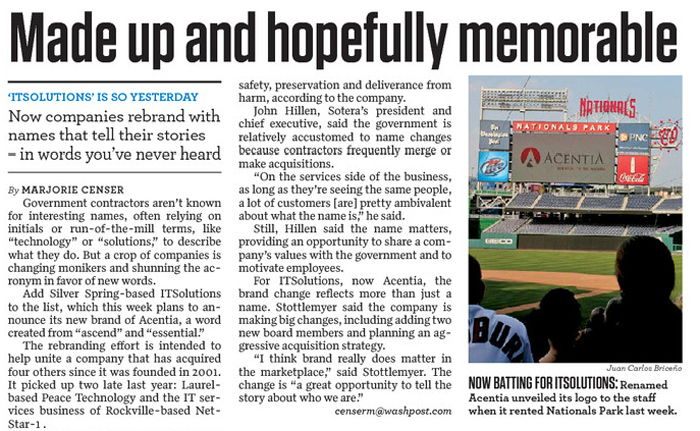
Bluetext launched Acentia at Nationals Park followed by major Washington media coverage.

Homepage
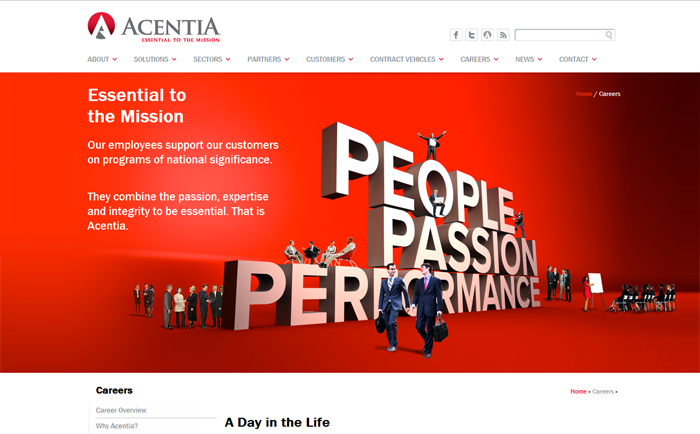
Careers Landing Page
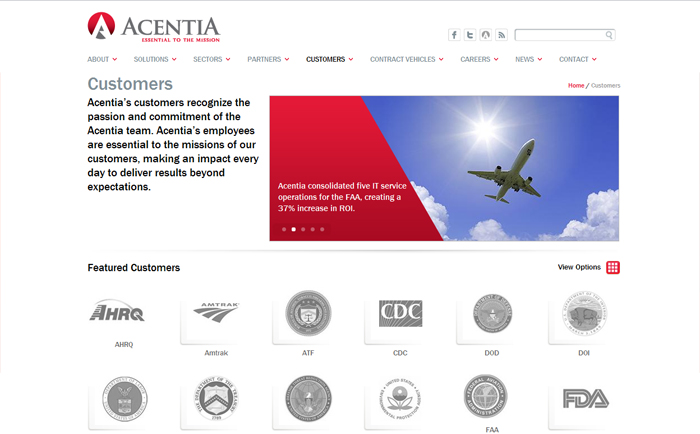
Customers Landing Page
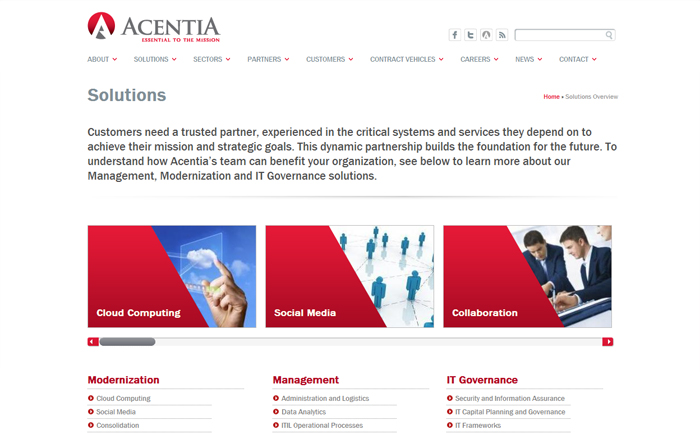
Solutions Landing Page
Bluetext produced a family of thought leadership videos to communicate sector focus inside Acentia.


The Google +1 strategy will make the search optimization maze even more complicated. The +1 will be integrated into everything today’s progressive marketer needs to drive brand recall and market leadership through integrated digital marketing and communications programs.
You may be aware of the Open Graph Protocol introduced by Facebook. With the Open Graph Protocol, all the content in the web, websites and the web pages are turned into the graph objects (if the concerned websites have decided to embrace Open Graph Protocol). What that means is that every time you go to a website or a web page and press the like button, you associate your profile with the graph object. The challenge with this approach for marketers is that it is creating a walled garden, which was one of AOL’s biggest downfalls.
Google’s open and transparent brand culture combined with the introduction of the +1 button will drive the kind of laser targeting marketers have been looking for with the Google platform beyond just targeting keywords. Gmail combined with +1 creates a social graph that is a tidal wave of dream data for marketers.
With +1 the search optimization game will drastically change because a site, blog, video, landing page, etc. will have search ranking impacted by collected +1s. Integrating the +1 everywhere in a brand’s marketing, and developing campaigns to drive your targeted audiences to “just +1 it” will be critical for driving this preferred brand position.
Open your eyes marketers. It’s time for a website audit to see where your +1s should go to be fully integrated throughout your digital media strategy. Bluetext can help you make these critical integrated marketing and communications decisions. Give us a shout if you need any assistance.
About FedMentors
FedMentors is a movement to educate and inspire the next generation of government leaders.
www.fedmentors.com | www.fedscoop.com