Private equity is reshaping how growth gets created, measured, and accelerated. The next era will belong to firms that pair financial discipline with brand, digital, and demand expertise at portfolio scale. This article outlines how executive teams can navigate the future of marketing private equity with a rigorous operating model, a data-driven demand engine, and a bold brand strategy that sets the pace from diligence through exit. For managing partners, operating partners, CMOs, and go-to-market leaders, the objective is clear. Treat marketing as a core value creation lever and build the repeatable systems that turn investment theses into measurable results.
Why marketing now sits at the center of PE value creation
Cost takeout used to dominate the early chapters of many deals. Today, limited partners and management teams expect consistent, efficient growth. Marketing private equity is the connective tissue between the investment thesis and the revenue plan. It aligns brand, positioning, product marketing, demand generation, and sales enablement to compress time to impact. It also creates a shared language for progress that boards can trust and operators can act on.
Three forces are raising the stakes. First, digital buying journeys now govern complex B2B and B2G decisions. Second, category noise has exploded, so signal matters more than share of voice. Third, insights and analytics are table stakes for capital efficiency, especially when interest rates amplify the cost of delay. Marketing private equity teams that operationalize these realities win earlier, scale faster, and exit stronger.
What a modern marketing private equity operating model includes
A repeatable operating model is how firms codify best practices across the portfolio without dulling the edge of each company’s differentiation. The core building blocks are consistent across industries and deal sizes:
- Value creation blueprint that translates the thesis into market positioning, prioritized segments, and the demand plan.
- Brand platform that clarifies who the company is, the problem it solves, and why it wins now.
- Messaging hierarchy and proof architecture that equip executives, sellers, and partners with crisp narratives backed by evidence.
- Full-funnel engine spanning SEO, content, ABM, paid media, lifecycle programs, and partner marketing.
- Revenue operations and analytics for pipeline visibility, forecasting accuracy, and cost discipline.
- Talent and governance model that balances a center of excellence with empowered portfolio CMOs.
- Agency and technology ecosystem that brings specialized skills while controlling fragmentation.
Firms that embed this model see better outcomes from marketing private equity because they shorten the strategy-to-execution cycle and protect the signal of the investment thesis as teams scale activity.
The 100-day plan for marketing private equity acquisitions
The first quarter sets momentum and clarity. A pragmatic 100-day plan for marketing private equity should focus on a few decisive actions:
- Audit the brand, pipeline, and performance marketing against the thesis. Identify gaps that block growth.
- Reconfirm ICP, TAM, and priority segments with updated win-loss and demand signals.
- Stand up a refreshed narrative and visual system if the current brand is misaligned or dated.
- Rebuild the website to clarify positioning, accelerate conversion, and support SEO topic authority.
- Instrument data for unbiased pipeline tracking, attribution, and board reporting.
- Launch pilot ABM and paid efficiency sprints to prove early pipeline impact.
- Align the sales playbook and enablement around the new messaging and target accounts.
This motion gives boards immediate visibility and gives operators a blueprint they can scale. It is a disciplined approach to marketing private equity that respects time, cash, and confidence.
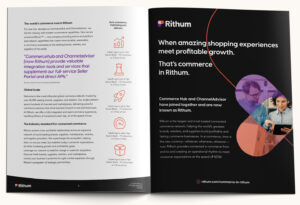
Explore how we built a scalable new brand for Rithum
Building portfolio-wide growth platforms
Operating partners increasingly run marketing private equity like an enterprise program. The goal is to reduce duplicated effort while lifting performance. The most effective centers of excellence focus on assets that can be templatized and reused. Examples include buyer journey maps, content frameworks, ABM playbooks, and event strategies. They also centralize select vendors and contracts that drive efficiency without constraining creativity.
Critically, a portfolio-wide platform should not become a bottleneck. Create a modular playbook that portfolio CMOs can tailor to their realities. Establish a recurring forum where leaders exchange test results and turn learnings into shared standards. The portfolio thrives when the best idea scales quickly across companies.
Standardize the tech stack without stifling agility
Fragmented martech erodes ROI. Rationalize to a standard stack for CRM, marketing automation, analytics, and data enrichment. Then allow optionality at the edge for ABM, intent, or content tools that match specific markets. Marketing private equity teams should set clear rules of engagement for data quality, attribution models, and privacy compliance. With shared instrumentation, the firm can compare apples to apples and manage to performance rather than anecdotes.
Brand architecture for roll-ups and carve-outs
Brand decisions carry material value in roll-ups, carve-outs, and integrations. Get them right and the portfolio scales trust and cross-sell. Get them wrong and you lengthen sales cycles and inflate CAC. In a roll-up, define the parent brand’s promise, then map how acquired entities ladder into a coherent architecture. Name and design standards should reduce friction while preserving critical equity where it exists. For roll-up strategies, our perspective on corporate roll-up branding can help leaders weigh the tradeoffs between master brand, endorsed brand, and house of brands models.
Carve-outs require different discipline. They need a complete identity and go-to-market in record time without losing customers or talent. That means accelerated naming, messaging, legal, and web programs that stand on their own. If your portfolio is preparing one or more carve-outs, explore our approach to a fast, defensible carve-out identity in our carve-out guidance.
Marketing private equity leaders should also rehearse the identity implications of future M&A at the time of the first deal. This keeps brand architecture from becoming a tangle as the strategy unfolds. A proactive brand workstream smooths diligence, protects valuation, and shortens the path to a unified demand engine.
Digital demand strategies that work in private equity timelines
Marketing private equity thrives on efficient pipeline creation. The highest performing programs tend to share five traits.
- Audience obsession. ICPs are defined by pain, trigger events, and propensity to buy, not by generic firmographics.
- Topic authority. SEO and content align to a few decisive themes that the brand can own, rather than chasing every keyword.
- ABM precision. Target-account plans match buying committees with tailored messages, creative, and outreach cadences.
- Paid media efficiency. Campaigns pair strong creative with rigorous testing, bid strategies, and landing page optimization.
- Lifecycle rigor. Nurture programs and partner motions progress accounts with relevance and timing, not volume.
Treat these as a system. Search insights inform content. Content fuels ABM. ABM sharpens paid. Paid accelerates testing and informs sales enablement. Lifecycle programs compound returns over time. This integration is what sets marketing private equity engines apart from random acts of marketing.
Account-based marketing for complex buying committees
ABM is a priority when deal theses depend on enterprise or public sector growth. Start with a finite list of must-win accounts and a defined set of buying center roles. Build a matrix of pains and proof by role. Develop a conversation architecture that can guide sequences across channels. Use intent, technographics, and first-party engagement to score timing. Marketing private equity teams should measure success on account progression, meeting creation, and pipeline quality, not only on lead volume.
Content that convinces CIOs, CISOs, and public sector buyers
Senior decision makers want clarity and proof, not fluff. Anchor content in customer economics and performance outcomes. Pair thought leadership with precise, referenceable case studies and solution briefs. For portfolios pursuing federal, state, and local markets, align content to procurement phases and compliance context. Building for B2G audiences requires specific expertise, and our team of B2G content and digital marketing experts can help portfolios craft messages that move through complex gateways.

Learn how we brought Arka’s new brand to life
Measuring what matters to the investment committee
Set a short list of shared KPIs across the portfolio and make them nonnegotiable. Give the board a clear view of progress and give CMOs room to optimize the inputs. Common metrics for marketing private equity include:
- Pipeline coverage by segment and stage, with conversion rates end to end.
- Sales velocity and cycle time by ICP and use case.
- CAC payback and channel-level cost per opportunity.
- Win rate by segment, deal size, and competition.
- Share of search and topic authority growth across priority themes.
- Expansion pipeline and net revenue retention drivers.
Agree on attribution and forecasting rules before the first board meeting. Use one source of truth for pipeline and let teams annotate results with qualitative insight. Marketing private equity teams build credibility when they anticipate questions and show levers that will move results in the next quarter.
Board reporting cadence and narrative design
Boards do not need a marketing textbook. They need a crisp story: what we aimed to do this quarter, what happened, what we learned, and what we will do next quarter to de-risk and accelerate. Create a two-speed report. The first is a single-page executive view tied directly to the value creation plan. The second is an appendix that shows channel diagnostics and experiments. This rhythm disciplines the operating model and accelerates decisions on budget and focus.
Preparing for exit with a market-making narrative
Great exits are not accidents. They result from years of consistent storytelling, brand proof, and customer advocacy. Begin exit readiness well before bankers arrive. Elevate the category narrative. Develop analyst and media relationships. Collect structured evidence in the form of customer outcomes, deployments, certifications, and third-party validations. Build a library of executive content and data visualizations that buyers and bankers can reuse.
Marketing private equity teams should anticipate the red flags that slow exit processes. Incoherent brand architecture, inconsistent messaging, and weak digital presence often require last-minute rebuilds. Address these early. For inspiration and evidence, explore a selection of our private equity work and how purposeful narratives increase valuation confidence.
Where AI fits when marketing private equity
AI can accelerate outcomes if it is pointed at the right problems with the right guardrails. Prioritize use cases that compress time to value: audience segmentation, subject line and ad variant testing, content outlines, predictive lead scoring, and anomaly detection in campaign data. Keep humans in the loop for strategy, positioning, and the moments where trust is on the line. Standardize prompts and workflows at the center of excellence so that portfolio teams benefit from shared learning. Then measure impact with the same discipline you expect from any program in marketing private equity.

Aevex needed to modernize their branding. See what we delivered.
Public sector growth as a private equity edge
Government markets reward expertise, patience, and precision. Yet for many portfolio companies, public sector growth represents an underleveraged lever. Winning here requires category fluency, compliance-aware messaging, and channel-specific tactics through resellers, primes, and contract vehicles. Marketing private equity teams that unlock B2G create defensible growth corridors and more resilient revenue. Bluetext brings deep B2G strategy and content capabilities that shorten the learning curve for portfolio executives contemplating a public sector push.
Talent, governance, and the operating cadence
Even the best playbook fails without the right leaders. For portfolio CMOs, prioritize adaptive strategists who can roll up their sleeves on analytics and content while managing agencies with confidence. Define a quarterly operating cadence that sequences strategy, activation, and retrospectives. The cadence should reflect how the firm manages other functional areas. When marketing private equity runs on the same clock as sales, product, and finance, value creation compounds.
Avoiding common pitfalls in marketing private equity
Several traps recur across deals:
- Spreading bets too thin across audiences and offers, which dilutes topic authority and creative quality.
- Scaling paid media before the message, website, and proof are conversion ready.
- Confusing activity with progress and presenting vanity metrics to the board.
- Retiring legacy brands before customers are ready or clinging to them beyond their usefulness.
- Underinvesting in enablement and partner motions that turn story into revenue.
Avoiding these pitfalls is as much governance as it is creativity. It is about sequencing and clarity. The right agency partner can help enforce that discipline while raising the creative ceiling.
Why Bluetext for marketing private equity
Bluetext partners with firms and portfolio leaders to turn theses into market momentum. We operate at the intersection of strategy, brand, and demand with a bias for measurable outcomes. As a private equity marketing agency, we bring repeatable frameworks for 100-day plans, brand architecture, and full-funnel growth systems tailored to investment timelines. We also bring deep sector fluency across cybersecurity, defense, AI, industrial, and public sector, which reduces ramp time and risk.
For roll-ups, carve-outs, and integrations, we accelerate clarity. For demand engines, we balance topic authority with ABM precision. For exits, we package evidence into a narrative that commands attention. That is the standard we hold ourselves to in marketing private equity, and it is how we help clients outperform their plans.
Next steps
If you are planning a new platform investment, integrating an add-on, rethinking your brand architecture, or rebuilding your demand engine, review our perspective on complex constructs like the corporate roll-up and the speed required in a carve-out. Then explore how our B2G content and digital marketing experts can open public sector opportunity for your portfolio. To discuss a 100-day plan, a value creation marketing roadmap, or an exit narrative, contact Bluetext to get started. Marketing private equity rewards teams that act early, move decisively, and measure what matters, and we are ready to help you do exactly that.
Recent Posts
Why B2B Companies Need a Brand Messaging Agency Now
Bluetext’s Recent Work