It has been a tremendous first half of the year for Bluetext across many fronts. We have won many exciting new projects, landed some very interesting clients, added some awesome staff, and taken on and won against some stiff competition.
In the last three weeks alone we were named public sector PR agency of record for two of the most recognized technology companies in the country, one on each coast.
For each of these two companies, the public sector is a critical market for their growth as each has technology that is in high demand across the Government. Interestingly, each company has a corporate agency which provided little support across the public sector, and each indicated that their agency did not focus on or “get” the public sector.
We get the public sector. We know how to effectively market and communicate in this market. And we know how to craft a PR campaign that is impactful to make noise and move the needle. Here are five recommendations to consider when thinking about your public sector PR program:
1. Get Creative. Product announcements don’t garner much coverage unless you are a massive company or it is a major breakthrough. But leveraging a trend in the market to talk about how your product can drive mission effectiveness can be a subtle but smart way to let your audience know about your new product or solution.
2. Government-ize the message. Take the product and solution announcements coming out of corporate and look at the messages that will resonate in this market. We know the public sector buyer is unique, therefore the message needs to be relevant and directed.
3. Make Your Content Consumable. Create listicles and snackables that can be shared easily across a wide variety of mediums.
4. Be Present and Relevant. Make sure your thought leaders are trained and ready to deliver a strong message. Many companies are competing for limited ink. The right PR team and the right message can go a long way.
5. Find the References. Sure, it is hard to get a Government customer to speak with a reporter about how they are using your technology. But if you approach them in a more subtle way to jointly pursue an award or speaking opportunity it can provide a great way to put your customers in the spotlight and begin the process of finding out how reference-able they really are.
If the public sector is an important market for your company and you are not garnering the right type of attention give us a call. We would love to talk about how we can deliver a campaign with impact…that is what we do best.
Brand Strategy
The Message and Brand Story
Rarely do you get a chance to work with a client so convinced that they can change the way cancer is diagnosed and treated that it energizes an entire agency. That was the case with Inspirata. After spending five minutes with founder Satish Sanan, it became clear that he had the resources, vision, and passion to shift an entire industry. With significant backing from major investors including the founder of NetJets, Satish came to Bluetext to launch a brand in a very short time. He wanted to focus on building and executing the business and asked us to develop a name, logo, messaging, website, brand story, process and video. The Bluetext team was up to the challenge.

The Name
Creating a name across the medical informatics industry is a challenge as every great idea seems to be taken. But after an extensive messaging process and a team that was open to exploring many possibilities, we came up with this concept of Inspirata, meaning inspiring data. By digitizing the entire pathology workflow process, Inspirata is focused on transforming cancer diagnostics and driving better patient outcomes for people across the globe. They are focused on inspiring a market and everyone fell in love with the name Inspirata.
Brand Presentation
The Logo
Clean, elegant, professional – that is the hallmark of this brand, and the logo is designed as a simple yet elegant mark that is recognizable but not overpowering.
Corporate Visual Identity
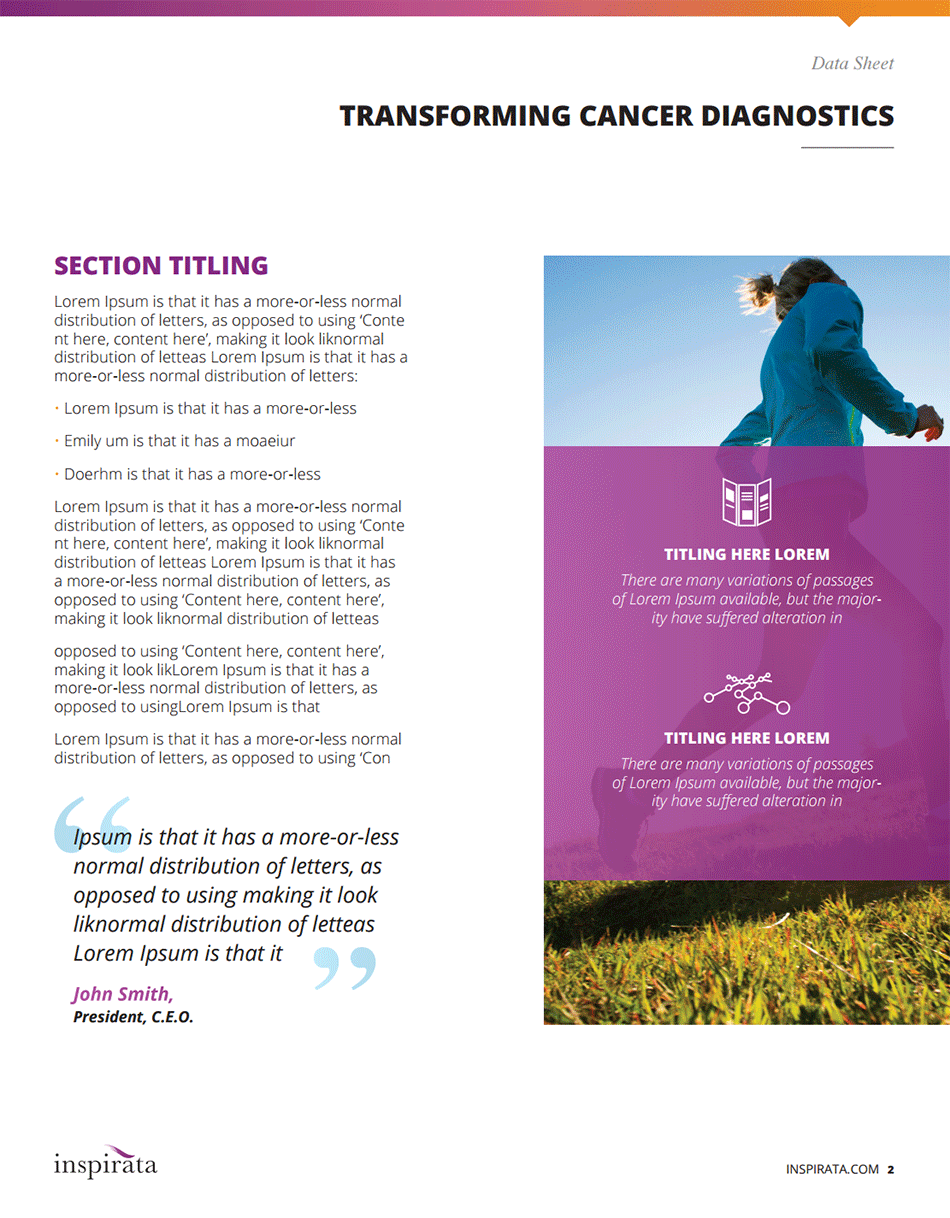
Bluetext designed a corporate visual identity system that aligns perfectly with the brand mission and story. It is simple and elegant but not overpowering.
Website
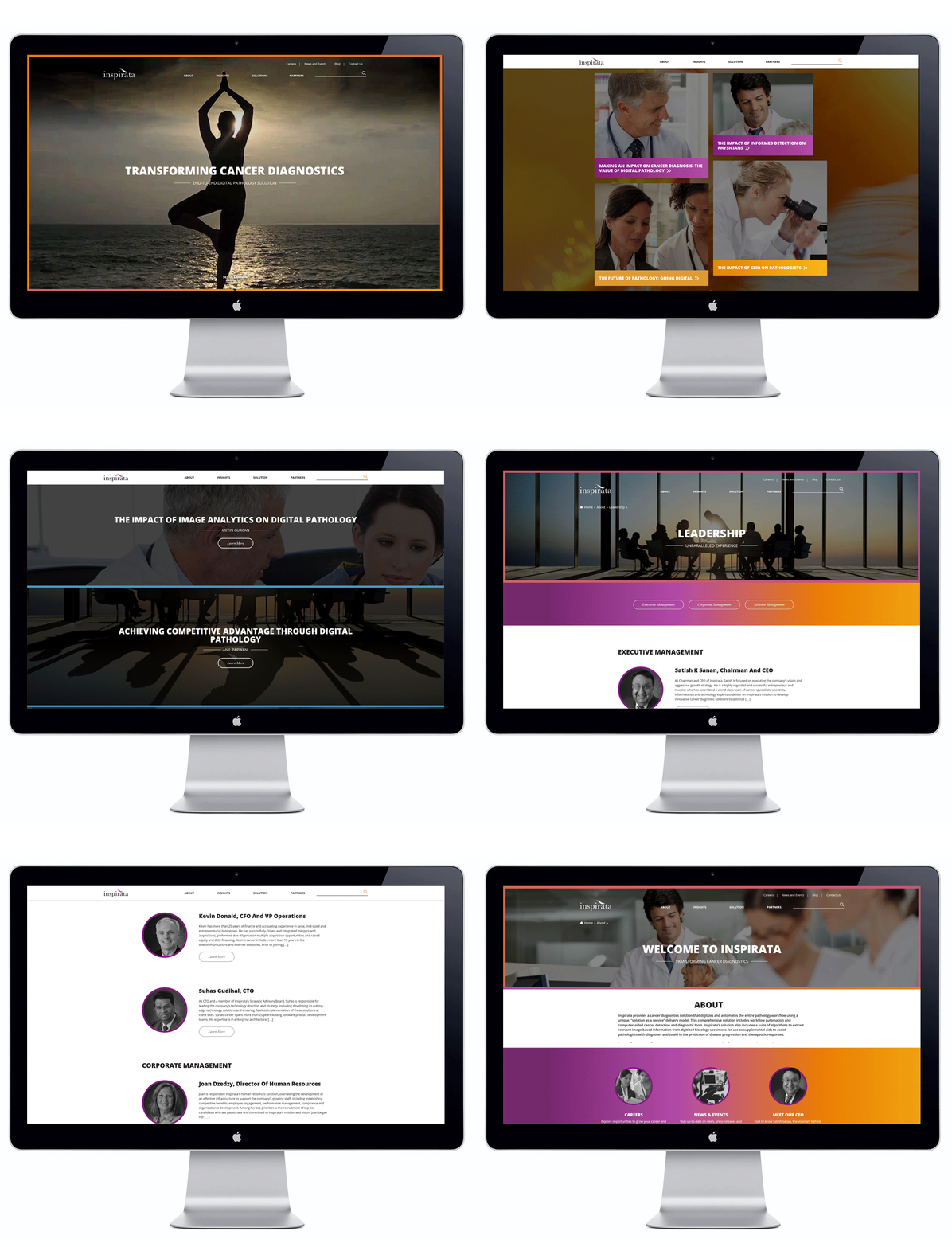
The centerpiece of the Inspirata brand is a powerful, responsive website designed to be easy to use, easy to navigate, and drive users down a path to understand the vision and mission of Satish and his entire management team. Big bold imagery, vibrant colors and lots of original content are the hallmarks of this powerful website which can be found at www.inspirata.com
Brand Delivery
In advance of the company’s launch at the USCAP 2015 Conference in Boston, Bluetext designed a powerful tradeshow booth to highlight the pathology office the future, designed an interactive infographic which demonstrates the company vision of transforming the case review of the future, and developed, in partnership with Philips, a partnership video to talk about the impact the two companies will have on the global digital pathology market.



If your digital marketing agency team doesn’t have a SMAC roadmap, you may find your company drifting off-course in 2017 and beyond. Here’s brief refresher course on SMAC.
Social Media
Social Media continues to evolve. Platforms rise and fall by the year vs the decades of old. Some new trends we see emerging that we see potentially continuing to gain momentum.
1. Snap’s Evolution Will Result in Interesting New Opportunities.
2. Twitter Fatigue Will Worsen.
3. Users Will Crave More Vicarious Experiences.
4. New Areas of Communication Will Emerge.
Mobile
Mobile devices are the cornerstone of how new business is being built and legacy businesses are reinventing themselves. Mobile devices allow users to constantly update their profile, stay aware of deals and promotions, and track locations and buying habits by virtue of connecting to various wireless signals and near-field communication (NFC) devices.
Some new trends we see emerging that we see potentially continuing to gain momentum.
1. Consumers redefine purchase boundaries; mobile marketing, brand partnerships deepen
2. Department stores, mobile marketing partners tackle the ‘Amazon Effect’
3. Programmatic accelerates: brands, tech, marketing continue to invest
4. Next-generation creative, video redefine mobile engagements
Analytics
As databases have grown larger and processors and memory have become capable of chewing through hundreds of millions of records in a short time, we have begun to see how analytics can do more than just track clicks. Analytics can establish links between entities and make intelligent predictions about customer behavior based on knowledge a system has about a customer — knowledge that has been informed by social networking.
To keep up with the explosion in Big Data, companies and corporations are beginning to invest in BI projects and more and more sophisticated analytics infrastructure. Some new trends we see emerging that we see potentially continuing to gain momentum.
1. Multi-channel Attribution
2. Focus on ‘Return on Analytics Investment
3. Monetization of Data
4. Exciting new players in the MarTech arena to complement the core analytic platforms
Cloud
The cloud element of SMAC refers to the capability a business has to spin up vast amounts of capacity that are paid for by the minute or hour. Businesses do not need to spend millions of dollars building another data warehouse – they simply rent it from a cloud provider, do their work and turn it off. When the business environment changes, they simply spin up another cluster in the cloud, pay another few hundred dollars and continue building insights.
Some new trends we see emerging that we see potentially continuing to gain momentum.
1. Artificial intelligence (AI) will make personalization a reality in 2017.
2. Self-service will be the new normal.
3. Enhancing the Buyer Journey
4. Google Tag Manager and other granular analytics modules being the norm
With buyer sophistication growing daily, marketers need to deliver increasingly smarter strategies and campaigns. Are you taking the time to measure how your efforts are working and think about how you might enhance your efforts, or do you find yourself quickly moving from one campaign to the next?
Need help with your SMAC TALK? Contact the digital marketing gurus at Bluetext.
As one of the leading digital marketing agencies in Washington, we get called in by a variety of prospective clients to discuss their needs. These clients are corporations selling to business, selling to government, or selling to consumers, and even associations and other industry organizations with unique audiences. Invariably they hone in on their target audience and want to see recent examples of work we have done for similar clients with similar targets. In other words, if they are selling directly to consumers, they want to see consumer case studies.
The more work we do across different industries and types of clients the more I am convinced that the question people should be asking is not have you done something similar for another client, but what are examples where you combined your creativity and ability to drive a unique message into a specific market. Let’s face it… a business buyer has a lot of similarities to a typical consumer buyer and the lines have blurred. They do a lot of research on their own, they want to read the reviews and see what other like-minded people think of the product or service, and they expect to engage with your brand in a unique, differentiated manner in order to take action. While the channels to reach them may be different and therefore the message needs to be able to translate easily, they want to be wowed with your product or service and they want to make sure you are addressing their needs.
Business and consumer buyers react to a strong message, delivered with impact in a creative way. They require multiple interactions. They are smart. They expect you to speak to them.
Now don’t get me wrong – consumer buyers are traditionally more emotional than business buyers, and business buying cycles are generally longer. I could write a similar post about the differences between the two. But as the world of marketing evolves and buyers have the power in their hands, the lines are clearly blurring.
So the next time you ask your agency for similar examples of client projects, maybe the better question to ask is “what examples can you share to demonstrate your passion and creativity to address a unique challenge.” The way the agency responds to this question, no matter their previous expertise or client projects, should go a long way in helping you decide on an agency partner.

We provide deep drupal development best practices with unique creativity and strategy to drive success for our clients.
Through discovery, our drupal developers and product managers create the perfect project plan aligned to your goals. Our drupal plan is customized to your needs. We have created drupal websites for clients across multiple industries, including commercial, government, education, non-profit, association, consumer, and native web designed for mobile.
Our technology team implements custom Drupal modules, design themes, server support and platform upgrades to meet your unique goals. For Bluetext, drupal is a platform to help you achieve your marketing and business goals – implementing goal is a means to an end, it is not the goal. Our full service approach includes:
- Strategy. Results from competitive analysis, focus groups and user surveys inform our decisions for Drupal features, as well as the site’s information architecture and content.
- Design. We provide a powerful Drupal design that reflects the brand, engages users and focuses on usability
- Content. By understanding your goals, audience and brand, we craft meaningful messaging that drive traffic and inspires action across your Drupal website.
- Marketing. With Drupal’s powerful email, search engine optimization and social media tools, we help you create long-term relationships with your users. Plus, we continually optimize campaigns with your ROI in mind.
A lot happens every 60 seconds online across digital platforms. In fact, a staggering amount of posts, uploads and emails take place in the space of a minute – every minute of every day. By looking at this data in detail, and comparing trends over the past three years, marketers can glean a lot of useful insight as to where to focus their brand’s attention when developing media programs – whether for specific targeted campaigns or for ongoing outreach.
A collection of these stats across the most important platforms was recently published by SmartInsights, and it reveals some significant trends. First and foremost, the 800 pound gorilla platform in terms of activity isn’t Twitter and it isn’t email. It’s Facebook. While there are nearly 450,000 Tweets every minute, there are 3.3 million Facebook posts in that same amount of time. In fact, if you said that Facebook literally dwarfs the other contenders, that would be accurate.
 Except when it isn’t.
As the stats show, the outlier that is the largest by far is What’sApp, the free cross-platform app that can do just about what every other app does, and encrypt it in the process – with more than 29 million messages sent every minute. It’s widely popular around the globe (although not so much in the United States yet).
And who owns What’sApp? Facebook, of course. See a trend here?
60 Seconds Online: Where to Focus?
So where to focus your media campaigns? Look at some of the trends for what’s growing the fastest, and what’s being left behind. For example, Twitter’s 2014-2015 growth line came way down for 2016. Yes, there are more Tweets than a year ago, but not by much. Facebook shows no growth from 2015 to 2016 – which could mean that it has reached its upward potential. On the other side of the spectrum, YouTube and Instagram have increased their activity significantly.
Let’s not forget – Facebook also owns Instagram, while Google owns YouTube. So the upstarts are really just growth opportunities for the giants who continue to battle it out for dominance.
What does all of this mean for marketers? We tell our clients to look at where the growth is, not what was hot two years ago. Twitter is great for sports, entertainment and politics, but not so strong for b2b marketing. Instagram, on other hand, is expanding its reach across demographics, and can reach new target audiences that may have not been a focus of previous campaigns.
Thinking about your marketing and media mix? Contact Bluetext
Get your mind out of the gutter. I’m talking about persistent navigation. But of course (wink)!
At Bluetext, we are designing and producing websites for the most exciting brands of all sizes across a multitude of industries. We live in the cross section of trends. We see things happening cross markets, and that can be essential when looking at user behaviors and preferences when needing to grab their attention and entice them to engage with a brand. And that means when we see a trend that is becoming more prevalent across platforms, we take notice.
The biggest new user-interface trend we are seeing today is navigation on the left side of the screen. Clients are calling this:
- Unique
- Different
- Fresh
- Smart
For us, this is going full-cycle, back to first-generation sites that were left dominant. But this isn’t your father’s left nav. These left navigation paradigms lock. They personalize. They respond to resolution and device and browser. They have many ways to expand and drill into the subpages structure of the site map with ease.
We see great brands like Qualcomm, VW, and Riverbed, all moving to left navigation systems.
Are you thinking about going left vs top for an upcoming site redesign? Here are five things to consider in making this decision:
- Is desktop a heavy user-base? If yes, then investing in slick navigation can pay off handsomely. If no, then it may not be worth the effort to do an adaptive responsive navigation module.
- Is your sitemap narrow and deep? If you answer yes, then you’re a strong candidate for a left nav.If you answer no and you have a bloated tier one navigation, then best to leave it alone.
- Does your brand logo work in the narrow navigation plate system? Many brand systems don’t contemplate this web application possibility. They also don’t have rules about stacking text about the logo mark. Or they show no name at all, just the logo icon.
- When you look at sites like Riverbed’s, you see the logo move over on scroll down. And when you look sites like ATT’s, you see they are throwing out the word all together. Just like Starbucks is doing everywhere.
- Is your target demographic a savvy web user audience? If you answer no, then consider a small user focus group to ensure they learn and adapt to the new navigation system paradigm with ease. If not, plan on going top navigation.
Here are some more sites that go left nav (or quasi left nav):
Thinking about redesigning your website. Contact Bluetext
Having worked with Drupal 8 in a production setting at one of the top development agencies for the last 15 months, I feel that I can responsibly say that Drupal 8 is ready for prime time. In fact, given all of the great improvements that the platform has to offer, it’s hard to think of an scenario where I would recommend Drupal 7 to a client. These include a standardized Symfony2 framework, a twig templating system, partial page caching, configuration management, layouts, and much more.
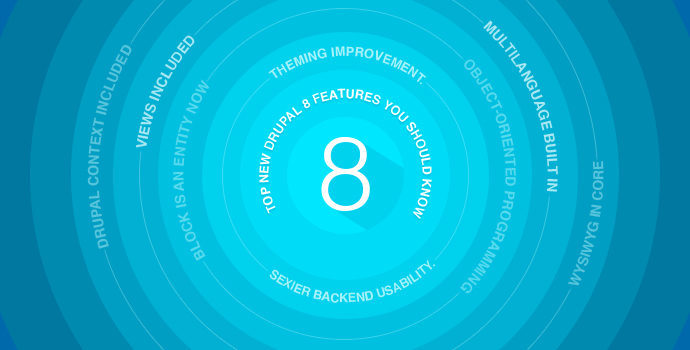
To learn more about Drupal 8’s new features, I spent a day recently at DrupalCon Baltimore, an experience that has heightened my excitement about Drupal and the future of the platform. Here are the takeaways that we got from the conference:
- Focus on Lowering the Barriers of Entry
- Core initiatives targeted at improving content authoring
- Revamped Release Cycles
- Drupal maturing in large enterprise
Opening the Flood Gates
The Driesnote was amazing as always. This one was more exciting than usual as there was a strong emphasis on the community and the shift for Drupal to become more user-friendly and lowering the barriers of entry. From a technical standpoint, the standardization on the Symfony2 framework and the addition of the twig templating system make working with Drupal more attractive to PHP developers, opening the platform up to a much wider developer market. From the content side, Dries highlighted the work being lead by Keith Jay to provide a better out-of-the-box experience to all users.
Content is King
In an ever changing market, it is important to stay ahead of the curve and adapt your organization to meet the needs of your client base. We validated a big shift that we are seeing in the market where the decision-maker is no longer the IT team – It has shifted to the marketing team. It is great to see Drupal follow this trend with the strong focus on the new core initiatives around UX, such as layouts and in-place editing. Dries also highlighted Cristina Chumillas for her work in improving the UX of several core pages.

Maintenance made easy
Another exciting announcement was around the revamp of the Drupal release cycles to make core upgrades for both minor and major versions of Drupal easier. The new 6-month cycles have been running great, and I for one am excited to see it. In this new model, functionality will slowly be deprecated (instead of removed) throughout the minor release versions as new functionality is added. This will give module developers an extended period of time to upgrade. Major releases will go one step further and remove the set of deprecated functionality to start the codebase off on a clean slate.
Climbing the Corporate Ladder
Drupal continues to gain traction in the large enterprise space with organizations and marketing teams looking to spend more of their budgets on content and campaigns rather than recurring subscription fees. This can be validated by the uptick in features and functionality that the community is providing for Drupal 8. As the market changes, so should the technology. The greatest thing about Drupal and the community around it is that we are the ones choosing the direction of the platform. We have thousands, or even hundreds of thousands of people validating this platform in the market and pushing the direction of the platform forward.
Bluetext continues to grow its commitment to Drupal and the Drupal community. If you are considering Drupal for your digital platform, please contact us. We would be happy to help you think through your approach to ingesting this powerful platform to power your growing digital ecosystems.
So, you want to sell to the federal government?
Good. Every year, Uncle Sam and his army of acquisition specialists have money to spend to achieve the critical missions of the federal government. In 2014, the most recent data available, the federal government spent nearly half a trillion dollars on contractors.
But there’s still another question left.
Who are you selling to? And I don’t mean which agency or which department. I mean, who?
Every contract issued by the government has a signature on it, an actual person who has selected your company to provide a product or service. Behind the signature are a small group of influencers. So, of that half-trillion dollar enterprise, your opportunity probably has been shaped by fewer people than are on an NFL roster.
So we ask again, who are you marketing to? Are you marketing to The Government or are you marketing to those who matter?
Why Personas Matter
Federal contracting is its own subspecies of marketing. We don’t have the intense feedback cycles or as many point-of-sale validations.
At Bluetext, we’ve helped dozens of clients reach the right government customers with carefully designed strategy backed by creative that makes an impact. It’s not always the same as business-to-business marketing or business-to-consumer, but one area that never changes is persona creation.
Why?
The government is not a single entity. It comprises agencies and departments, which in turn comprise directorates and activities and program management offices and thousands of personnel who play a role in acquiring products and services on behalf of the government.
How you reach them all won’t be the same. The avenues available to market to a program manager in the access-controlled world of the Intelligence Community, for example, won’t be the same as those available to reaching a director at the National Institutes of Health. Their missions aren’t the same, their needs aren’t the same, and their pain points aren’t the same.
Even within your target opportunity, your approach must vary.
Unlike traditional commercial services marketing, where you may aim for a thousand buyers of a million dollar contract, in federal marketing you’re more frequently aiming for one sale of one 100 million contract influenced by a dozen people. Not only does the persona exercise of understanding who your buyer is matter in fed tech, it matters even more.
Government Personas, in Four Broad Strokes
Directors and Deputy Directors and High Ranking Government Executives
This is typically the big ideas crowd. They’re usually looking for what’s next. Their interest is less day-to-day and more focused on how to better achieve their agency’s mission. Major changes begin at this level, whether it’s a product like a weapon systems or the federal cloud-first mandate, which has reshaped federal IT since its issuance by the then Chief Technology Officer of the United States. In the Intelligence Community, the largest IT transformation in its history began as a plan issued from the Director of National Intelligence.
Be bold and be visionary. If you want to radically change the government’s mindset, this is where you enter the bloodstream. Personnel in these positions aren’t always technically savvy and often have a more generalist approach to their departments, but they’re always eager to find the next great idea. They’re intensely focused on mission achievement, so help them understand how your solutions helps them better achieve the department’s goals.
Contracting Officers & Program Managers
What is a contract for your company is a career decision for contracting officers (COs) and program managers. On most acquisitions, the PM and the CO (or KO, as it’s often abbreviated, particularly in defense) are the most important decision maker. The program manager will be responsible for oversight of all the requirements in the proposal and of its execution once underway. The CO/KO can later modify the contract to add scope.
While PMs and COs appreciate the big idea, they are also intensely interested in the nuts and bolts and your capability to deliver. Every contract is an act of trust between these two positions and your company. These are experienced government personnel with whom you’ll want to build a long-term brand relationship. Depending on the size of the contract, they may not be subject matter experts in all technologies involved, but will likely understand enough to separate contractor-speak from actual capability.
Acquisition Influencers
For competitive bids, acquisition is done through an evaluation board which helps advise the source selection authority on its choice. Acquisition influencers are often subject matter experts and will be interested in the details. While their interest is in the proposal before them, your marketing should include this group as well. Are there third-party validations you can include to bolster your technical credibility, such as CMMI appraisal or AWS or Microsoft organizational certifications? Is your accounting system approved by a government auditor? Can you demonstrate applied expertise in your area of work, through white papers and blog posts? The big idea is great, but this is the group that will pop your marketing balloon if your big idea is all hype and no substance.
End Users
The role of a federal contractor is never simply IT for IT’s sake or product for product’s sake. It’s about empowering the end-user to achieve agency mission. And while the end-user, be it a help desk technician, a service member or a scientist, won’t sign a contract, their opinion of your product or service, particularly once it’s in use, will heavily influence whether it continues to be in use. Prior to acquisition, a groundswell of support could be cause for a pilot program. Market to the end-user’s pain points, rather than a technology-first view.
Every contract is different and Bluetext has helped dozens of clients craft specific marketing strategies by agency and by opportunity.
But like all marketing, it doesn’t just start with the what, it starts with the who!
In their drive to attract, engage, recruit and ultimately retain new members, Association marketers are facing added competition not just from other trade associations, increasingly they are being squeezed by for-profit commercial businesses that have ramped up their own efforts to attract this same audience. One of the primary services that associations offer to their members is information, in the form of content.
The majority of the critical information that members used to get solely from an industry association today can be easily found and obtained elsewhere—and typically free of charge with no annual membership fees. The American Heart Association for example – once had a near exclusive lock as the sole source of premium content for all things related to the heart. That role kept membership strong and growing. They now are now facing increasing competition for share of mind from hospitals, medical groups, for-profit businesses and manufacturers of prescription drugs for the treatment of cardiovascular disease. As more competing content sources compete for mindshare, the less valuable the association becomes as a leading resource for information – let alone a ‘paid’ resource.
Associations and nonprofits should look at this as not just a challenge in terms of member acquisition but also as a major threat to their member engagement and retention strategy. And what aggravates that is the fact that many lack the resources and strategy to run robust and ongoing integrated member acquisition and retention campaigns to keep existing and prospective members engaged.
The bottom line is, Associations can no longer rely on historical or traditional tactics to acquire and retain members – they need to get into the content game and start producing fresh, relevant content to drive traffic and engagement. This is not a simple task—it takes a disciplined approach that regularly creates and distributes new insights, ideas and information, packages them in a concise and compelling way that attracts attention, and communicates the value that the content delivers to its members. And to be truly be effective, that content must also be search engine optimized to make it easy to find, and properly coded with relevant keywords in key areas of the site that Google is looking at, including page URLs, page titles, and content across the association’s website. When this is done properly, a dashboard can be set up to track, measure and optimize engagement and conversion of the content marketing program.
With organizations of all sizes jumping into the content game – it is absolutely critical that you begin a smart content marketing strategy to re-capture and retain the membership base and reclaim your stake as the dominant voice of your industry.