It may be a surprising question. Google, after all, is a search engine, Facebook a social network that by all appearances is the hot property over the past 12 months. The number of users is growing exponentially, and investors believe it is worth billions of dollars. But there is real evidence that Facebook is inadvertently losing its primary attribute– intimate social interaction– that truly differentiates it from the all-data driven promise of Google. It may seem counter-intuitive and will, take a little explaining, but it all became clear when reading Time Magazine’s Person of the Year cover story in December on Mark Zuckerberg, Facebook’s erratic founder.
The gist of the difference between the world’s largest search engine and the world’s dominant social networking site goes something like this: When you look for information on Google, such as restaurant critiques, movie reviews, suggestions for vacation resorts, or anything else you can think of, you are getting the wisdom of strangers. When you seek that same information on Facebook, you are getting the recommendations from friends. The latter would seem to be more valuable for most people because it is from individuals with whom they have those types of relationships, and not from faceless (and often nameless) Internet personalities.
That’s just one example of the utility of Facebook. It is also much more of a place to have a dialogue with people with whom you have a relationship with– to see what they are up to, what they are reading, or how their families are doing, or just to look at their photographs. In other words, where Google is about broadcasting information, Facebook is about engaging in conversation with friends.
But look what’s happening on Facebook when it comes to having “friends.” The definition has changed– dramatically. In the off-line world, friends are people with whom you share experiences, spend quality social time, and interact with on a personal level. In the Facebook world, the meaning of the term “friend” goes far beyond that– it is anyone who hits the “accept” button.
My daugthers each have well over 800 friends on Facebook. In their off-line life, the number is a fraction of that. I have one colleague who has more than 3000 friends on Facebook. When he asks for movie recommendations, even from his Facebook friends, the response is no different in my mind than from a Google search– it is merely the opinion of strangers who happen to be friends by this new definition.
From a practical stand-point, there is no way he can follow the news feeds of those 3000 friends, not can he engage in any meaningful conversation. When he posts a status update, links to an article or video, talks about his weekend, he isn’t engaging in dialogue on a personal level with anyone. He is simply broadcasting his posts, hoping that, as with Google, people will see it. When online friends don’t really have the same attributes as off-line friends, the social networking component disappears.
What does this mean for communications professionals? For one, Facebook can be a great place to broadcast information far and wide. But it’s going to become a more difficult place to actually engage key audiences– be they consumers, customers, employees, policy makers, or just friends.
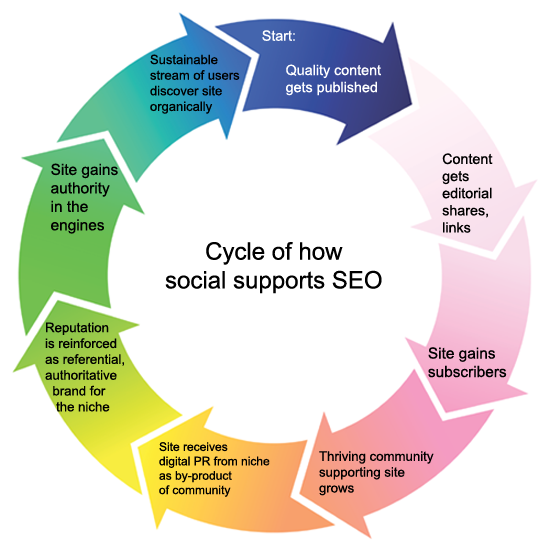
Social networking and search engine optimization will be forever linked and integrated for progressive marketing strategies. Good marketers know that the two work hand in hand and the linkage is growing more powerful daily. This graphic summarizes the Social SEO cycles in today’s hyper-connected environment.
As innovation in search and social continues, these platforms and ecosystems will continue to find valuable integration pathways between one another. As brands fight for relevancy and stay on the edge of what’s hot, the two systems truly need one another. I believe these brand categories will blur into a consolidated category. Will this just be “media” or will this be truly “digital media.” User experience consultants can help their clients by creating digital media strategies to embrace these changing times.
Here are 10 reasons to rethink your social strategy with a complete SEO integrated layer:
1. Search engines are smarter than ever before. You must embrace their new inteligence. The value of truly earned organic, editorial links will only continue to increase in value.
2. Earned links are the modern media hit factories of yesterday. A strong social strategy will earn a growing amount of editorially-earned links daily.
3. Being fresh with your editorial pace and content will enable you to get more link baits for authoritative domain fish out in the sea.
4. Frequent Updates = frequent visits by spiders, humans and everything in between.
5. Social web success brings increasing returns. Likes and other rating systems influence search algorithyms.
6. Social is sustainable. An honest, well-nurtured community strategy will naturally progress, keep you focused, and build domain authority.
7. Links aren’t good enough. You need strong PR digitally and offline. Strong endorsements contextually to your brand will help your digital reputation strategy.
8. Ride the wave. With 600 million people spending 30 minutes a day on Facebook, your focus should be there.
9. Social scavengers produce links more likely than any other first-time brand user.
10. Stay compelling and of high quality when producing content.