Whether you’re selling B2B, B2G or B2C, chances are you’re starting to experience a crowded market space, with fierce competitors all vying for the same clients. Make sure your lead gen program is working as hard as your competitors’.
Let Bluetext do a Free Assessment of your lead generation content to make sure you are getting the best results.
Topics can include:
- Overall Marketing/Branding
- Target Audience
- Lead Generation Strategy
- Media Strategy
- Search Engine Optimization
- Social Media/ Blogging
- Website/Landing Page Conversion Optimization
- Content Strategy
- Lead Nurturing Strategy
- Analytics/ Website Management
For a FREE Lead Generation Assessment, sign up here!
The lowly infographic, once a novelty but more recently a must-have for markets trying to quickly a complicated message, seems to be in the twilight of its existence. What’s more properly referred to as a data visualization used to command the attention and admiration of marketing professionals everywhere. It wasn’t too long ago that such iconic and influential infographics as Aaron Koblin’s map of aircraft flights in the U.S. was dazzling us and pushing everyone towards this engaging new medium.
It’s easy to see why infographics became the darling of the marketing world. People like to be able to visualize complex issues. Our eyes are more comfortable scanning images than wading through data. And with the explosion of big data, making sense of all for that information through text alone can be difficult. We have worked with dozens of clients on ways to visualize and animate their complex data. The truth about infographics is that they are effective when done well, and will continue to be a valuable asset in the marketing toolkit.
Then why do they seem to be falling out of favor? Indeed, according to Sarah Rapp with the portfolio-sharing site Behance, “Infographic posting generally rose steadily from 2007 to 2012, where it peaked, and has begun to decline since then.”
As Fast Company contributor Mark Wilson wrote in a recent blog post, “A few years ago, the Internet was awash in groundbreaking data visualizations…Today, you’d be lucky to find a cheap knockoff in a world dominated by crappy promotional infographics churned out for viral attention.”
There are a few trends that help explain why infographics may seem like they are losing steam. One of the most obvious is the move to mobile, and as any reader of our recent blog post on the latest Google search algorithm change has learned, websites that aren’t mobile friendly are getting dinged in web searches. The reason is obvious—beautiful and intricate graphics typically do not translate to small-screen devices. If smartphones and tablets make up more than half of today’s web traffic, that’s a massive amount of viewers on which a sprawling data visualization would be lost.
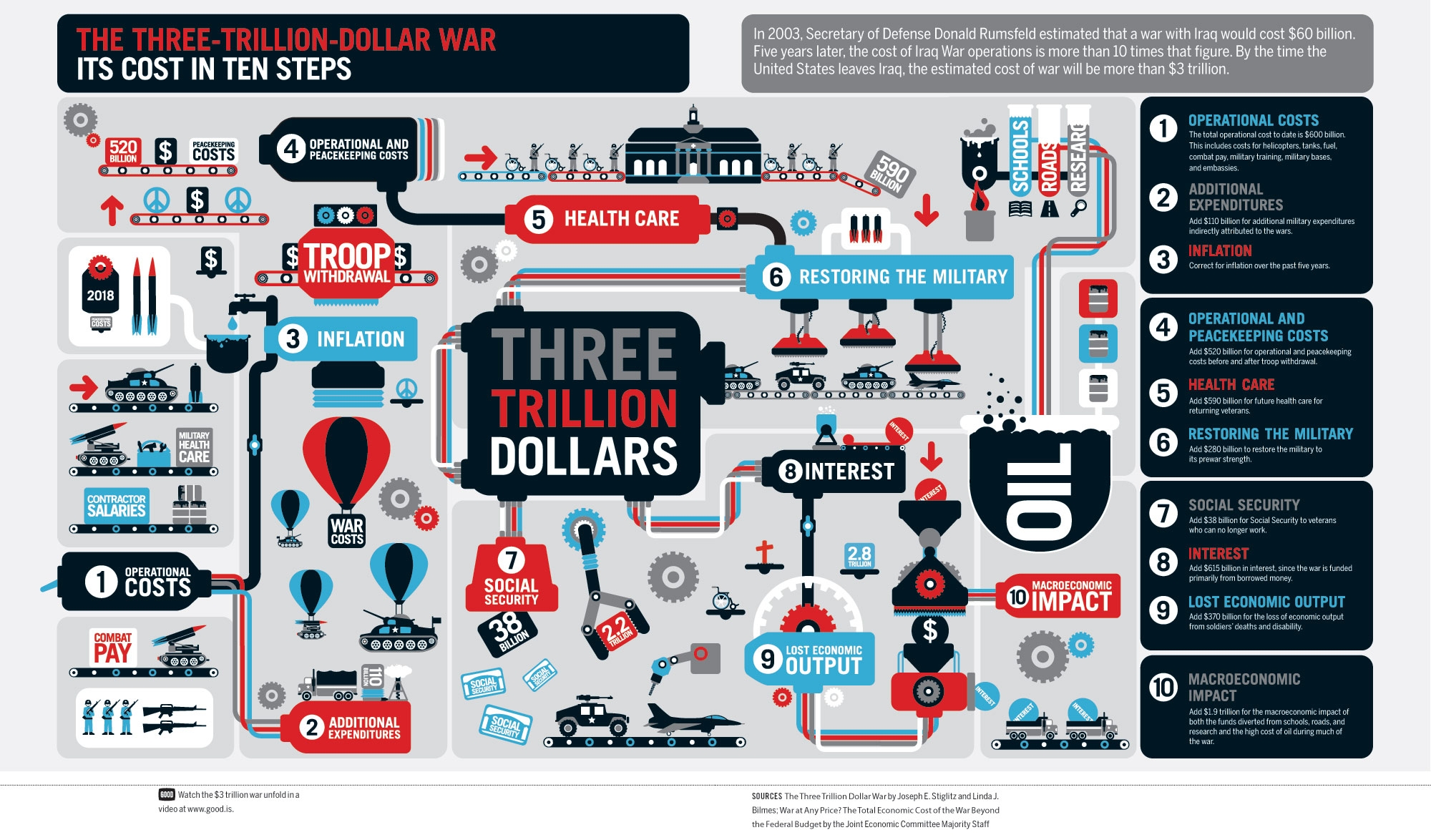
Another is more basic. Many infographics try to pack in so many details and so many data comparisons that they become incomprehensible. Rather than simplifying information, they end up confusing the viewer to the point of their eyes glazing over. Good designs are simple and eye-catching, not complicated and mind-numbing. Here’s an example of data overload:
Finally, as Mark Wilson notes, in many ways infographics have gone mainstream. “Once a playground for independent designers, data visualization has evolved into something more mature, corporate, and honest about its failings,” writes Wilson. “The quirky, experimental infographics that once peppered the Internet may be disappearing. But that’s only because data visualization, as a medium, has finally grown up and gotten a job.”
Bluetext comes at visualization from a different angle. We often work with our clients on what we call “StoryGraphics.” StoryGraphics, as the name suggests, tell a story rather than relying on comparative data to draw comparisons. In many cases, this is because the client may have key messages but not have data that lends itself to clever charts or graphs.
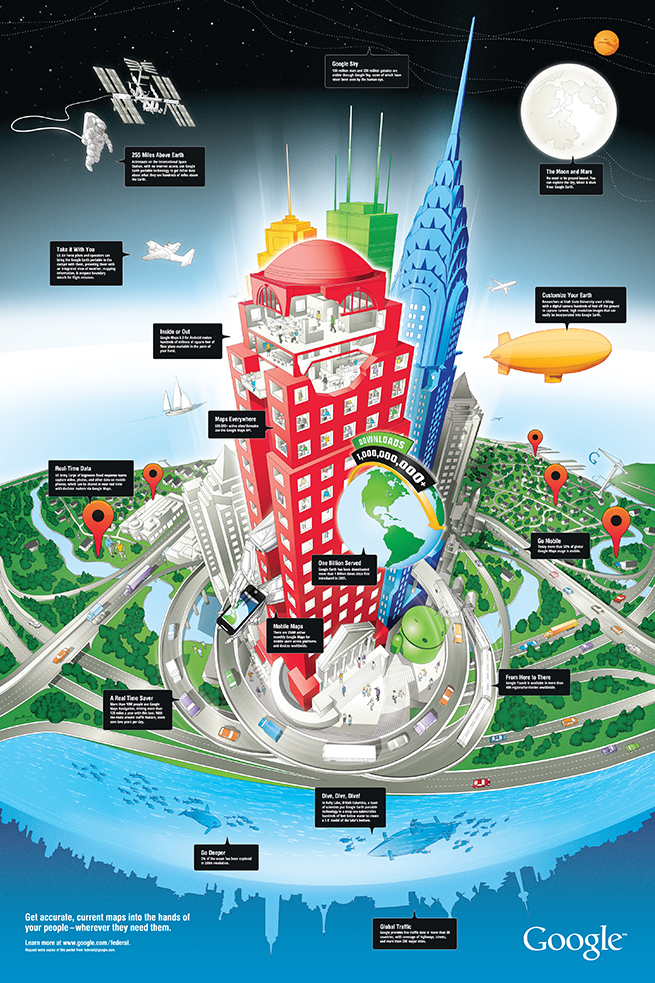
In a design we created for Google recently, the StoryGraphic tells how geospatial information can be used in space, for aviation, at all levels of commerce but also on the water and under the seas. A huge success for the Google enterprise team, this graphic would never have succeeded as a typical infographic.
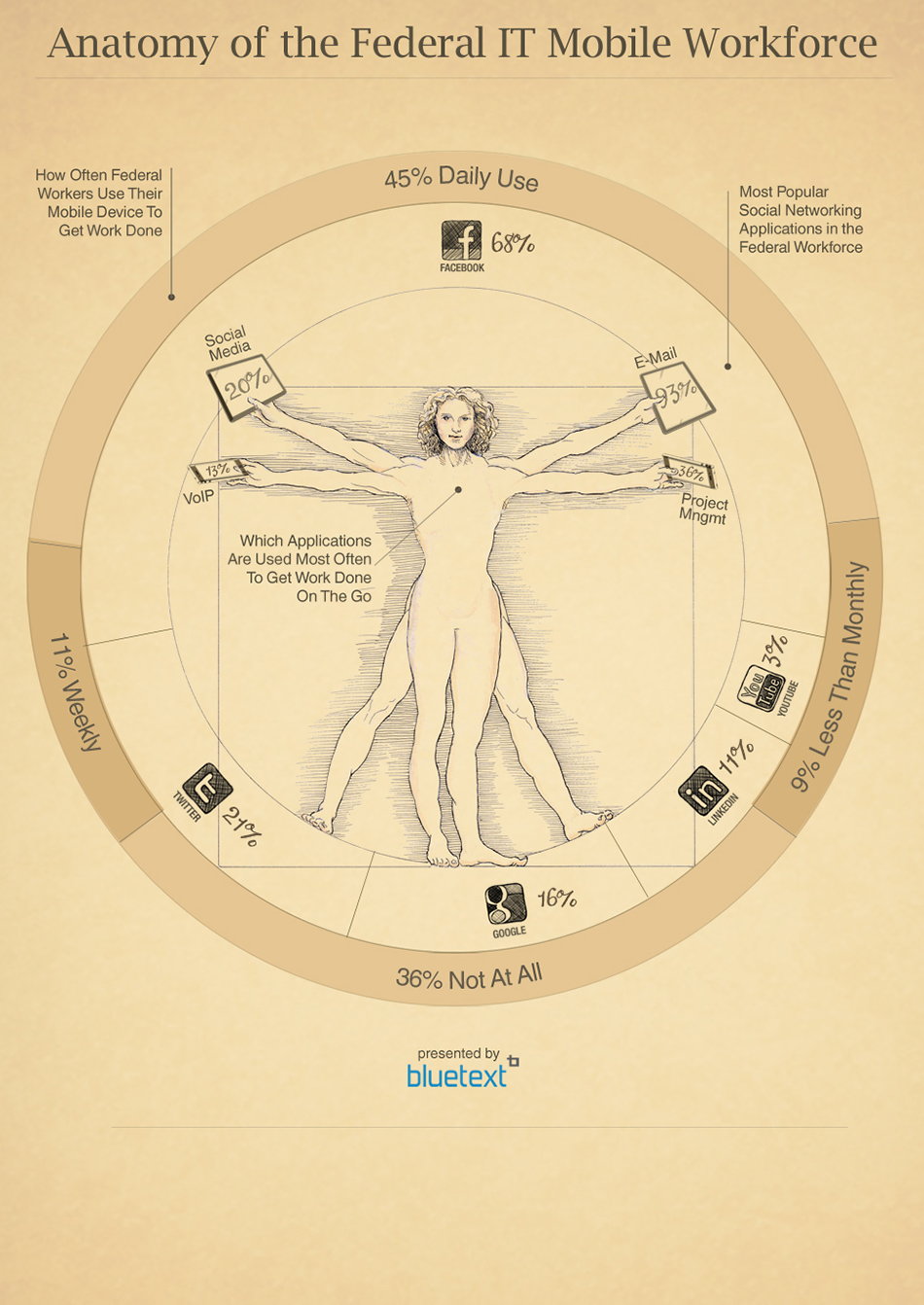
Another Bluetext example shows the move by Federal workers towards mobile devices. While data plays a role in the graphic, it leverages an iconic image to draw the viewer into the story that is being told.
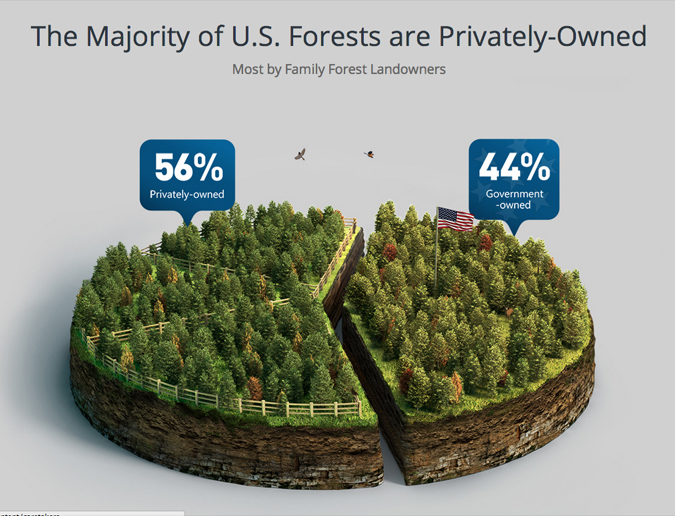
Some of our most compelling client examples do rely on comparative data, but focus on a limited number of statistics to more effectively tell the story. For a design for Georgia Pacific, one of the world’s leading wood products companies, we created a pie chart that took the form of a forest with just one cut down the middle to visualize the difference between government-owned and privately owned forests. The design instantly conveys the surprising fact that there are more private forests than government forests.
You can find compelling and intriguing examples of Bluetext StoryGraphics and infographics here in our portfolio. The bottom line is that marketers can turn to more sophisticated ways of using graphics to tell stories than a confusing jumble of facts and figures.
CSC’s Nick Panayi and I presented at the 2015 Mid Atlantic Marketing Summit on the customer journey and how digital marketing technologies are continuing to evolve, personalize and empower this very effective demand generation platform. We drilled deep into CSC’s massive digital infrastructure that supports many of their journeys, and most importantly the Bluetext produced CSC Digital Briefing Center. Slide 56 shows some outstanding results.
The Mid Atlantic Marketing Summit is greater Washington’s largest annual symposium of thought leaders in marketing. The theme focused on emerging technologies and trends in marketing communications. Topics included: metrics, mobile, social media, multi-platform campaigns, online video campaigns, experiential advertising, B2B, business development, and much more. This summit explored the disruptive technologies that are creating a major shift in how marketing and business development professionals reach their audiences and decision makers.
Bluetext Presents with CSC on Digital Customer Journey from Jason Siegel
and Nick Panayi, Head of Global Brand and Digital Marketing
As business grows, driving innovation can be challenging. Bluetext recently developed this mascot character to inspire one of our clients to drive innovation and promote an innovative spirit across its global client projects.
Bluetext named her Ana-Vation – a female spin on the key phrase Innovation.

Bluetext loves these kind of creative challenges. We see companies like consulting firms and government contractors that need to find ways of driving innovation as employee de-centralization and work on client sites can be a cultural challenge.
Here are some ideas to drive innovation in your marketing, branding, and overall cultural efforts:
- Be easygoing.
- Hire for culture.
- Bring on people who love the work they do.
- Build a diverse workforce.
- Manage innovation in a transparent methodical fashion.
- Schedule time for brainstorming.
- Tolerate and expect mistakes.
Tactical is a great word…if you are in law enforcement or the military. As a digital marketer, however, tactical has come to imply – fairly or unfairly – a lack of strategy, creativity and inability to grasp how day-to-day activities fit into the bigger picture.
In the recent Forrester report, “2015: The Year of the Big Digital Shift,” more than half of marketers admitted their digital marketing is more tactical than strategic. While a number of factors may explain this, digital marketers are a victim of their own excess: Forrester reported that investments in marketing technology grew 3.4 percent in 2014 and is projected to rise another 4 percent this year.
Marketers looking to spend their growing budgets will find an ever-expanding landscape of digital marketing tools at their disposal. Ask peers for recommendations on tools for content marketing, marketing automation, mobile marketing, SEO, and social media monitoring and you will likely get dozens of answers. It reminds me of the viral marketing videos from Blendtec’s, “Will It Blend” campaign, whereby items ranging from iPhones to baseballs are placed in a Blendtec blender to see if, in fact, they will blend. Throwing a bunch of digital marketing tools into a blender and just hoping they will “blend” together into a coherent strategy doesn’t work.
To ensure digital tools enhance rather than complicate your broader marketing strategy, consider the following:
Conduct gap analysis
Marketers must draw a definitive line between nice to have and need to have digital tools. In my recent column for PR Week The Hub Comms, I reviewed a new gap analysis tool from SAP that asks the marketer a series of questions about their organizational profile, marketing programs, current systems and processes. Based on the answers, the tool makes personalized recommendations on focus areas for marketing investment to address existing gaps. Marketers should not make tool investment decisions before having a firm grasp of existing gaps, and then evaluating which tools can plug them.
Avoid tool redundancy
There are purpose-built digital marketing tools designed to address a single pain point, such as SEO or content marketing. But it is more common today to find tools that try and do multiple things. For example, one tool might be capable of social media management, PR media measurement and reporting, while another might include a PR media database and some social media management capabilities. Many of these tools don’t run cheap, which means you do not want to be paying multiple vendors for essentially the same service.
Don’t repeat the same mistakes
The path of least resistance is continuing to use the same tools year after year. It is certainly possible that a small handful prove invaluable and are worthy of your loyalty, but the fact is that marketing needs evolve over time and your marketing strategy must adapt accordingly. The key point is that your digital marketing strategy should drive the tools you use, not vice versa. Purchasing a tool or tools and then building a marketing strategy around the tool’s capabilities is a backwards approach that will leady to tactical, rather than strategic decisions. Evaluate what worked last year and evaluate tools that will help you achieve objectives in 2015.
Don’t buy tools in a vacuum
Marketers, particularly those in the technology industry, often talk about how their company or client solutions break down silos and allow for information to be more easily shared. We see that playing out across agencies as far as a need to integrate digital marketing tools with other areas of the business. Burson-Marsteller recently unveiled a new approach aiming to combine its data analytics and Web data tools with creative and production capabilities, indicative of efforts industry-wide to cast the benefits of analysis, data and measurement organization-wide.
The Mid Atlantic Marketing Summit is greater Washington’s largest annual symposium of thought leaders in marketing. The theme will focus on emerging technologies and trends in marketing communications. Topics will include: metrics, mobile, social media, multi-platform campaigns, online video campaigns, experiential advertising, B2B, business development, and much more. This summit will explore the disruptive technologies that are creating a major shift in how marketing and business development professionals reach their audiences and decision makers.
A presentation being given by:
Nick Panayi, Global Brand and Digital Marketing, CSC
Jason Siegel, Co-Founder & Chief Creative Officer, Bluetext
Location: Mid Atlantic Marketing Summit
Gannett Building
May 8th 3PM
Nick and I will be presenting on the customer journey and how digital marketing technologies are continuing to evolve, personalize and empower this very effective demand generation platform. We will drill deep into CSC’s massive digital infrastructure that supports many of their journeys, and most importantly the Bluetext produced CSC Digital Briefing Center.
Learn why CSC’s Digital Briefing Center was so strongly needed for their most critical journeys, the concepts considered, and how we got to this great performing end product.
Force3 marketing leaders Joel Moore and Tasha Klares talk about the Force3 rebranding efforts.
This week, just in time for its Global Sales Conference in Orlando, Bluetext client CSC (NYSE: CSC) launched its redesigned, fully responsive website. This was an incredible collaboration that the Bluetext team is so pleased to have been involved with from the beginning.
As one of our largest clients, CSC is always pushing Bluetext to think outside the box to get more creative and push the limits for the global brand. Over the past year we have collaborated on several exciting projects including their Digital Briefing Center (http://www.csc.com/digital_briefing_center/aut/110681-digital_briefing_center) and their Manufacturing industry go to market web experience (www.csc.com/OM).
Last fall we proactively approached them to highlight several areas of their corporate website that we believed could evolve. I guess it is just in our nature to try and proactively look at our clients key marketing channels and make recommendations to push them out of their comfort zone in ways that we feel could be executed more flawlessly.
Our client Nick Panayi, Head of Global Brand & Digital Marketing for CSC, spearheaded this effort and had this to say:
The thing I value the most in Bluetext as a true partner is that they don’t tell us what we want to hear, but what they truly think is needed with solutions ready. You cannot teach an agency to do that. That is in the DNA of the agency. And once you find that, my recommendation is to keep that agency around for a long time.
The new fully responsive website design centers around the key technology focus areas that CSC is driving solutions for into market. Big beautiful imagery and clear calls to action, all aligned with cross industry brand efforts are hallmarks of the new site. We worked with their in-house development team to integrate many modern techniques, including a snap navigation for a seamless browsing experience and a smart lazy loading strategy for fast browsing.
The launch of the new csc.com is the first phase in a multi-phase rollout for CSC with new phases rolling out in the coming weeks. We are very proud of our partnership with CSC.
Triblio’s CMO and Co-Founder Jason Jue talks about trends in marketing automation, analytics, and digital marketing.
While it might seem like a bad movie plot, websites that aren’t friendly to mobile devices are about to be in for a rude awakening. In late February, one of Google’s top webmasters announced in a blog post that the dominant search engine was about to make a significant change to the way it ranks search results. Beginning on April 21st, its search algorithm would increase the weight it gives when returning search results to what it called “mobile friendliness.” Not only does that mean that mobile-friendly websites would enjoy better results, it also means that sites that don’t meet those standards will face the consequences. Some have already dubbed it “Mobilegeddon.”
The stampede from desktops to the wide variety of shapes and sizes now available as tablets, cell phones and even wearables—think Apple Watch—that has taken place over the past several years is only getting larger. A recent survey by ComScore Networks—a firm that analyzes internet traffic and trends—found that in the final three months of last year, desktop searches in the U.S. decreased, while the searches with smartphones jumped 17 percent. The volume of tablet searches increased 28 percent.
And while many of our clients have made this shift to mobile friendly, they are in the minority. A survey by Didit.com took a look the sites of the largest companies to see if they have adopted a mobile-friendly approach. Didit looked at the home pages of publicly-traded companies on the Standard & Poor’s top 100 list by checking them against Google’s “mobile-friendly test page.” The result—some 25 percent of those home pages failed the test, including the Walt Disney Company, a brand that is typically at the forefront when it comes to leveraging technology for visitors to its theme parks.
The Disney home page looks great on a desktop. But as the screen size gets smaller on table and mobile devices, the Google tool found that the text was too small, the links overlapped each other and the content was often wider than the mobile screen.
We’ve been working with our clients for the past four years to make the move to responsive designs that automatically resize their user interface depending on the size of the display screen. A responsive site takes a standard website and instructs the mobile device on how to display it properly. Responsive websites can handle any resolution with changes in CSS files, which affect how the elements on Web pages are presented. Computers, laptops, smartphones, and tablets will all display the website in the best way possible.
One of the reasons responsive design is so important is the “fat finger” problem—as menus shrink, it becomes nearly impossible to engage the functionality since our fingers are too big. Responsive designs shift the menus from ones that are driven by discreet buttons to larger options that are easier to see and easier to select. Without this type of design, visitors will be frustrated and leave the site in search of one that is user friendly.
This approach insures that the website appropriately presents itself on every size display, from the smallest to the largest. Another approach is to have a separate mobile website. Yet, since new devices in different sizes seem to hit the stores about every 10 minutes, this could be a large problem for websites, and certainly would not be cost-effective.
To put this in perspective, while this is a significant move by Google, it doesn’t mean you have to panic. Some of us have been advising our clients for several years that more and more users are accessing their websites via tablet and mobile devices. Google is simply responding to the shifting trends of how consumers are accessing the web. It will not unduly penalize a website that doesn’t immediately meet its requirements like it did in previous search changes—you can still make the move to a mobile-friendly site and see your rankings adjust accordingly. And if you haven’t been paying attention to the marketplace and to the shifting needs of your audiences, you may have a bigger problem than Mobilegeddon.